Introduction
The blockchain world is evolving rapidly. In 2026, smart contracts remain the foundation for building decentralized applications (dApps), Web3 projects, NFT marketplaces, and DeFi ecosystems. As an IT company specializing in blockchain development, we constantly assess which ecosystems offer the best performance, security, and scalability.
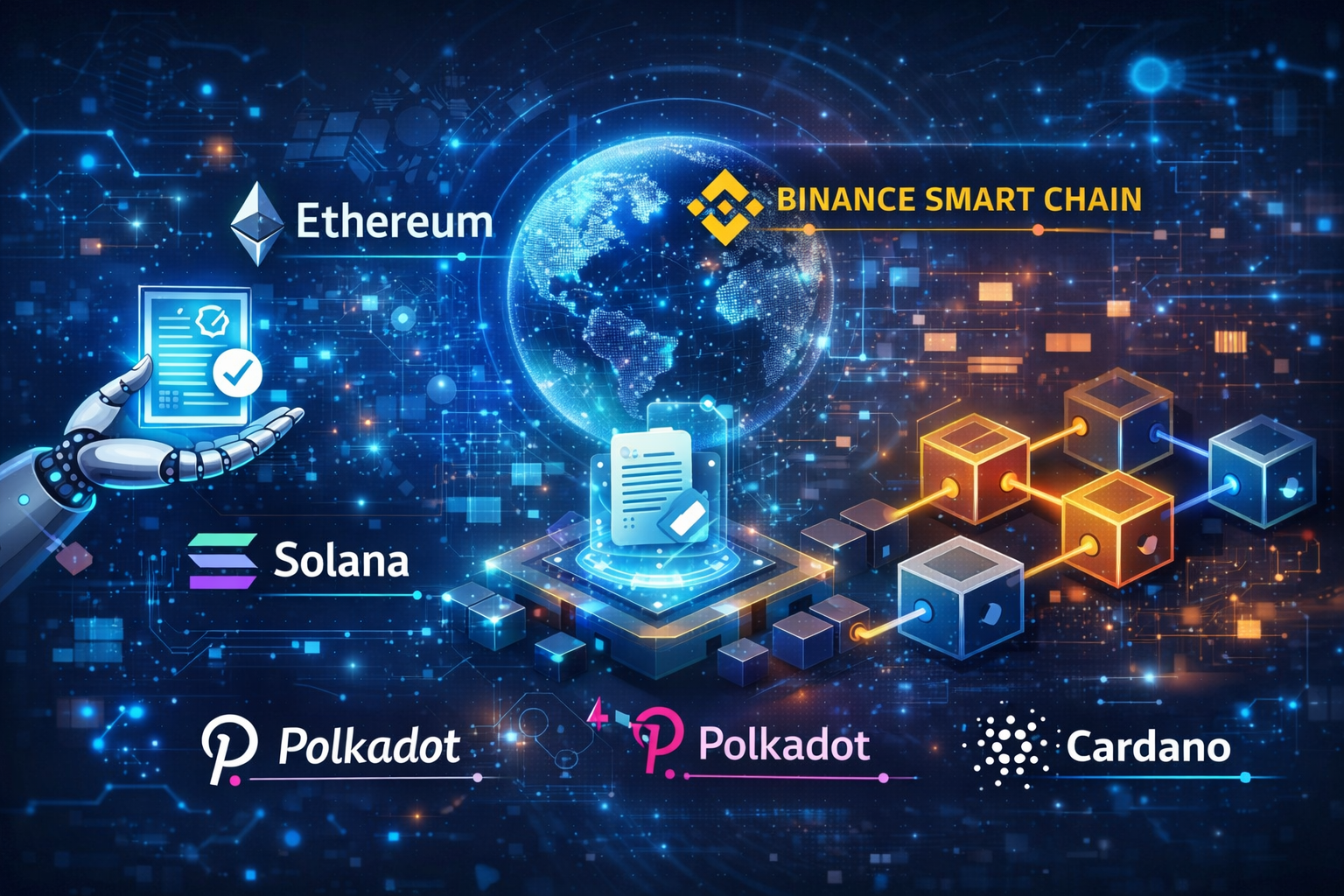
In this article, we share our expert ranking of the top 5 blockchain platforms for smart contract development in 2026.
1. Ethereum — The Gold Standard with a Robust Ecosystem
Ethereum remains the most popular platform for smart contracts. Despite network congestion and high transaction fees at times, its infrastructure is second to none. With Solidity, EVM compatibility, a vast toolset, and a strong developer community, Ethereum continues to lead.
🔹 Advantages:
- Largest developer community
- Powerful tooling (Hardhat, Truffle, OpenZeppelin)
- Proven security
🔻 Drawbacks:
- High gas fees (though mitigated by Layer 2 solutions like Arbitrum and Optimism)
2. Solana — Speed and Scalability with Low Fees
Solana focuses on high throughput (up to 65,000 transactions per second). Thanks to its Proof of History mechanism, it’s an ideal platform for large-scale applications such as gaming, NFTs, and financial tools.
🔹 Advantages:
- Extremely low transaction costs
- Fast performance
- Ideal for mass adoption
🔻 Drawbacks:
- Still a relatively young ecosystem
- Occasional network stability issues
3. Polkadot — Modular Architecture with Cross-Chain Communication
Polkadot allows developers to build their own blockchains (parachains) that interact with each other. This provides flexibility for unique functionalities without the constraints of a central network.
🔹 Advantages:
- Modular design
- Built-in cross-chain communication
- Supports both Ink! (native) and EVM-based smart contracts via Moonbeam
🔻 Drawbacks:
- Steeper learning curve
4. Cardano — Scientific Rigor and Long-Term Vision
Cardano is known for its scientific and peer-reviewed approach to development. Its smart contract language, Plutus, is based on Haskell and emphasizes formal verification.
🔹 Advantages:
- Strong focus on security
- Low energy consumption
- Sustainable, research-driven development
🔻 Drawbacks:
- Less beginner-friendly
- Smaller library and tool ecosystem
5. Avalanche — Speed and Customization for Business Use
Avalanche enables developers to launch isolated blockchains (subnets) tailored for specific business needs. It's a strong choice for private or hybrid blockchain deployments.
🔹 Advantages:
- High scalability
- Custom blockchain creation
- Strong support in the DeFi space
🔻 Drawbacks:
- Smaller ecosystem compared to Ethereum
Conclusion
In 2026, the choice of blockchain platform depends heavily on your business needs:
- Looking for reliability and maturity? — Go with Ethereum.
- Need speed and affordability? — Solana or Avalanche are great picks.
- Want modularity and flexibility? — Choose Polkadot.
- Value academic rigor and sustainability? — Cardano is your answer.
Our team can support your project at any stage — from choosing the right blockchain platform to developing smart contracts and launching production-ready applications. Ready to bring your idea to life? Let’s talk.
Have a project like this on your desk?
Send us a few lines about where things stand. We will read it, tell you what we would look at first, and whether we are the right people for it.
Talk to us about your case